Serving Denver and the surrounding area
Concrete that endures
Your project should last—and your money should be well spent. Start with a no-pressure estimate in 60 seconds below. We’ll help you choose what’s worth the money and best fits your goal, drawing on decades of experience building driveways, patios, walkways, foundations and more.
- Licensed & insured
- Se habla español
Get a free estimate
Your estimate is a starting point. We confirm the final price after a free on-site walkthrough.
Click a step you’ve reached to revisit it.
What are we pouring?
Pick everything you’re considering — we price it as one visit, which is cheaper than booking them separately. Not sure what it’s called? Use Something else and describe it.
We selected Stairs to get you started. You can change it or add other work.
Example photos · credits
Client project photos are used where available. Other photos are illustrative examples; credits below.
- Donald Miner · CC0 · Thumbnail display cropped
- ChicagoConcrete · CC BY-SA 3.0 · Thumbnail display cropped
- W.carter · CC0 · Thumbnail display cropped
- Beams&Lintels · CC BY-SA 4.0 · Thumbnail display cropped
- ChimaBee · CC BY-SA 4.0 · Thumbnail display cropped
- Retainingwallexperts · CC BY-SA 4.0 · Thumbnail display cropped
- Wikideas1 · CC0 · Thumbnail display cropped
- Khaosaming · CC BY-SA 3.0 · Thumbnail display cropped
- CheMechanical · Public domain · Thumbnail display cropped
- Chris Gentrup · CC BY-SA 4.0 · Thumbnail display cropped
What to expect
From your first estimate to finished concrete, here’s what happens next.
Tell us about your project
About 60 secondsAnswer a few questions with our free estimator Get an estimate You’ll get a price estimate for your project right away — no pressure or waiting for a callback.
What you doRough size is fine. We measure properly later.
We walk the site with you
30–60 minutesWe measure, check truck access, assess drainage for proper water runoff, and mark sprinklers and utilities. Then you get an official quote you can access through your portal.
What you doBe there if you can. Five minutes of your questions saves a lot later.
You decide through your private portal
Your call — no pressureUse your project portal to sign the quote when you are ready, or follow up with questions or additional thoughts. We won’t move forward until you are ready.
Half of the agreed price is due the day excavation begins. The rest is not due until the project is 100% complete and you sign off.
What you doWhen you are ready, sign and confirm the start date.
Work begins
Usually 2–5 days on siteMost of the work is excavation and preparation. Pouring and finishing often take only a few hours. Concrete sets quickly; we remove the forms when it is ready.
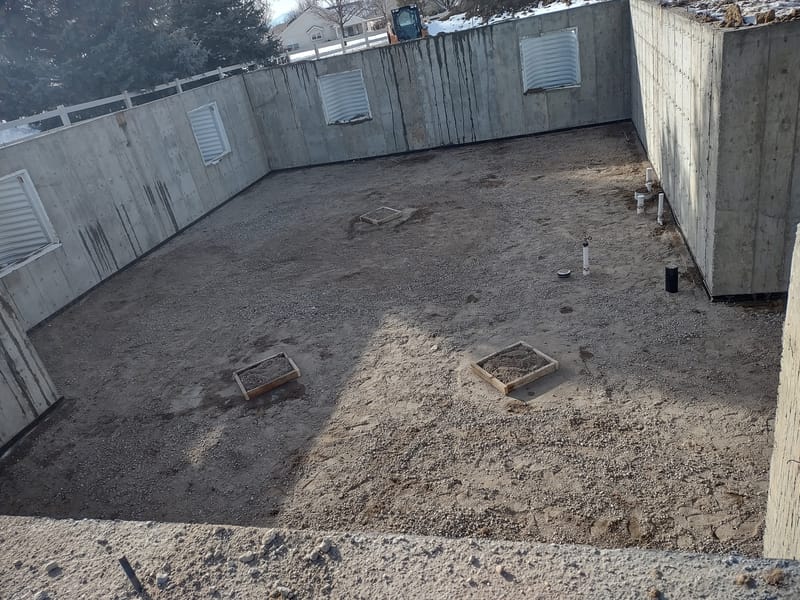
1 Excavation
Remove existing material and excavate to the planned depth.
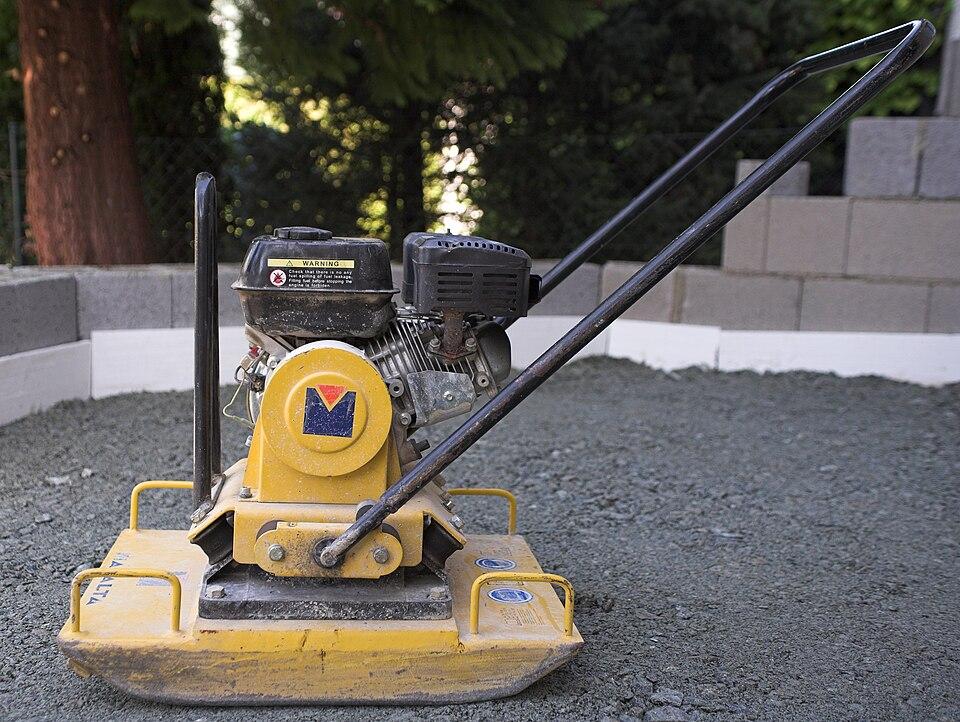
2 Compaction and road base
Compact the ground and add the road base your project needs.
Illustrative photo: Mr.checker · CC BY-SA 3.0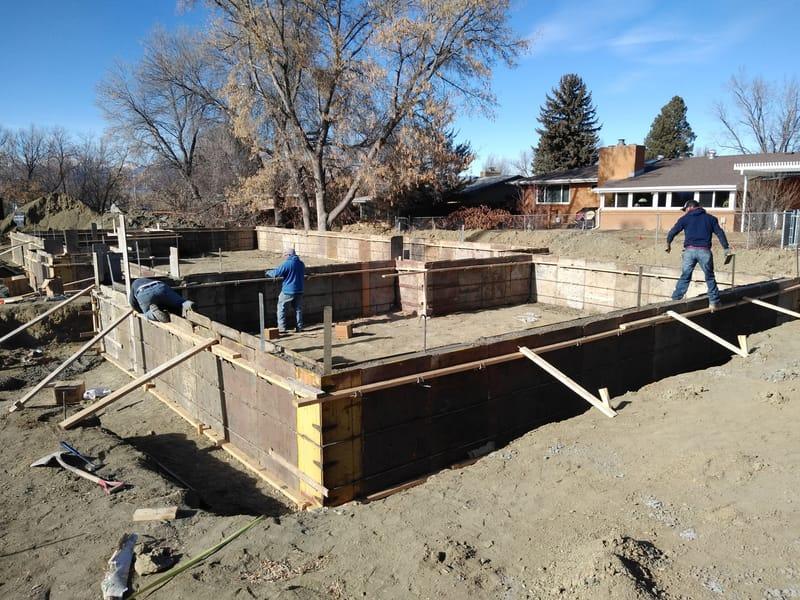
3 Forming and rebar reinforcement
Set the shape and slope, then support rebar at the correct depth.
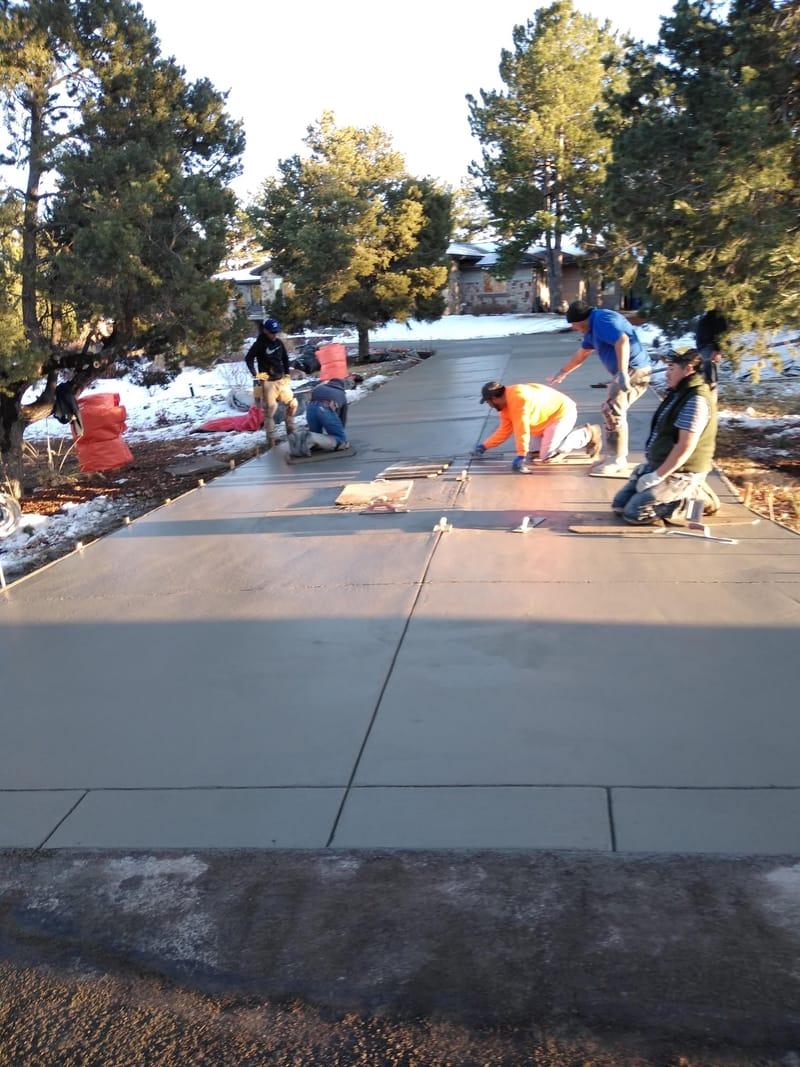
4 Pouring
Place, level and finish the concrete.
What you doMove cars out the night before. Keep pets and kids clear on pour day.
When you can use it again
Minimum 24 hrs to useWalk on it after 24 hours — a day longer for stamped. Park a car on it after 7 days, when it has reached roughly 70% of its strength. Wait roughly 28 days before an RV, a loaded truck, or a dumpster. Keep off the edges early on; they are the weakest part. Cold weather slows all of this down.
What you doSet reminders for when you can use the new concrete.

Timings are typical for a straightforward job in good weather. Curing slows markedly below 50°F, and we will tell you if that affects your dates.
Make your money count
Start with the essentials for lasting concrete. Open a topic to see what is worth paying for.
We’ll help you choose what your project needs, explain the trade-offs and recommend upgrades only when they serve your goals.
Start with solid groundGood preparation protects your investment.
Soft spots, loose fill and changing soil moisture can cause movement. We evaluate the ground and drainage before choosing the base preparation. Expansive soils may need additional evaluation.
- Worth itUniform support and a plan for proper drainage.
- Not worth itExtra concrete or adding more road base than is needed to compensate for ground that has not been properly prepared.
Choose the right thicknessThicker concrete is worth it when your project needs it.
For a driveway, heavier vehicles may call for thicker concrete. We recommend the thickness based on how you’ll use it and the ground beneath it. Foundations and footings follow their required design.
- Worth itThickness suited to how you will use the concrete.
- Not worth itExtra thickness with no clear need, or as a substitute for ground preparation.
Our recommendation: Project-specific recommendation, confirmed at the walkthrough
Choose a mix for Colorado weatherStrength is only part of durability.
Outdoor concrete exposed to freezing needs an appropriate air-entrained mix. Tiny air pockets help relieve pressure as water freezes. We select the mix for your project’s exposure and design.
- Worth itA mix and installation suited to the conditions.
- Not worth itPaying for a higher PSI number without understanding the benefit.
Source: NRMCA: Scaling Concrete Surfaces
Plan for crackingCracking is expected and cannot be completely avoided.
Concrete will crack as it hardens, dries and moves. Quality work combines proper ground preparation, joints, reinforcement and care after pouring to control cracking and protect the concrete’s integrity. Most small shrinkage cracks do not compromise its integrity; widening cracks or uneven surfaces need a closer look.
- Worth itProper joints, support and curing.
- Not worth itA promise that concrete will never crack.
Rebar protects your investmentCorrect placement matters as much as including it.
We include rebar in our projects by default because it helps control cracking and protect your investment.
Properly installed rebar helps limit crack width and protect the concrete’s integrity. It must be supported at the depth the design requires, with enough concrete above and below it—not too high or too low. Rebar controls cracking; it does not make concrete crack-free.
- Worth itRebar supported in the correct position for your project.
- Not worth itPaying for rebar that is not positioned correctly.
Give concrete time to develop strengthSetting quickly does not mean full strength.
Concrete continues developing strength after it sets. Time, temperature and proper care affect that process. We guide you on when it is ready for the way you plan to use it.
- Worth itAllowing time for strength to develop, with guidance for your project.
- Not worth itAssuming a hard surface means concrete has reached full strength.
Source: NRMCA: Curing In-Place Concrete
Are sealers worth it?Choose one for a clear benefit—not a promise of no cracks.
Sealers are often chosen to enhance color or add a sheen. They do not strengthen concrete or prevent cracks. Some penetrating sealers also help reduce water and salt exposure. We help you decide whether the appearance or surface protection is worth the cost; sealing does not replace quality concrete work.
- Worth itA finish you like or surface protection suited to the exposure.
- Not worth itA sealer sold as necessary for structural integrity or crack prevention.
Source: NRMCA: Scaling Concrete Surfaces